The Simple Fix Indian Men Are Missing
Physiotherapists across India see it regularly — a persistent, low-grade pain on one side of the lower back or hip. It affects men between 25 and 50. And its most common cause is sitting on a thick wallet.
This condition has a clinical name: posterior wallet syndrome, sometimes called fat wallet syndrome. It is not a serious medical diagnosis — but it is real, documented in physiotherapy literature, and entirely preventable.
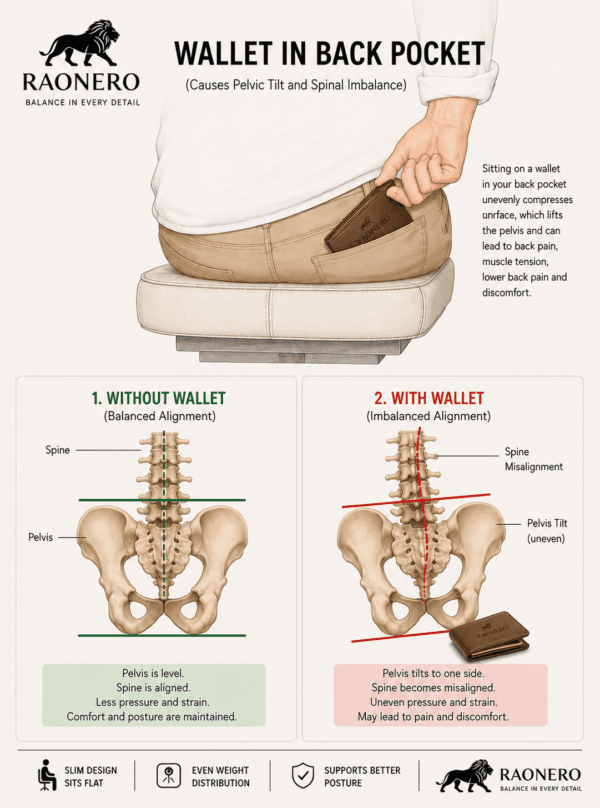
When you sit on a thick wallet positioned in your back-right pocket, your right hip is elevated by the height of the wallet. For a fully loaded trifold, that elevation is typically 15–22 millimetres.
Your spine and pelvis do not simply tolerate this asymmetry — they compensate for it. This manifests as a lateral pelvic tilt — your pelvis rotates slightly, your spine curves to maintain balance, and muscles on one side of your lower back work harder.
Over hours, this produces muscle fatigue. Over weeks and months, it produces muscular imbalances. Over years, it can contribute to sacroiliac joint dysfunction and chronic lower back pain.
Orthopaedic research has found that pelvic tilts of just 5–10 millimetres can produce measurable changes in lumbar spine alignment. A loaded wallet elevates by two to four times that amount.
Moving your wallet to your front trouser pocket eliminates the back-pocket asymmetry entirely. Most men who make the switch within two weeks report that front-pocket carry feels completely natural.
Remove every loyalty card, expired card, and card you haven’t touched in the last month. Get your loaded wallet under 10 millimetres thick. At that thickness, the back-pocket elevation is minimal and much less likely to cause issues.
Keep a very slim wallet in your trouser pocket for the 3–4 cards you use daily. Store remaining cards in a cardholder in your bag, car, or desk. You carry what you need, store what you might need.
The decline of cash as a dominant payment method in India has done something the health community could not: it has given Indian men a rational reason to carry less.
When UPI handles 80% of daily transactions, the argument for a 12-card trifold collapses. The average digitally active Indian man under 35 genuinely needs 3–5 cards and occasional cash.
The minimalist wallet — slim, full grain, front-pocket friendly — is not a Western import. It is the logical response to how payments actually work in India in 2026.
| Wallet Thickness | Back-Pocket Risk | Recommended Action |
|---|---|---|
| Under 8 mm | Minimal | Continue back-pocket carry if comfortable |
| 8–12 mm | Moderate | Consider slim-down or front-pocket carry |
| 12–18 mm | High | Front-pocket carry strongly recommended |
| 18 mm+ | Very High | Switch format immediately — trifold or stuffed bifold |
Yes. Sitting on a thick wallet for hours creates asymmetric pelvic elevation that leads to spinal compensation and muscle imbalance over time. Physiotherapists recognise this as posterior wallet syndrome or fat wallet syndrome. Switching to a slim wallet or front-pocket carry typically resolves the issue within weeks.
Aim for under 10 mm when loaded with your normal carry. Wallets thicker than 12–15 mm in a back pocket create significant pelvic asymmetry during seated hours. Slim designs perform best when under 8 mm when loaded.
Yes — and increasingly common. Front-pocket carry works particularly well with slim cardholders or front-pocket wallets. It is more secure against theft in crowded environments and eliminates the posture issues of back-pocket carry.
For men whose back pain is caused or worsened by wallet-induced pelvic asymmetry, yes. Most report noticeable improvement within 2–4 weeks of switching to a slim front-pocket wallet or significantly reducing their back-pocket carry thickness.

